The new BrainVision Recording Format (BVRF) and how to use it

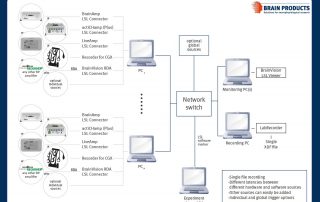
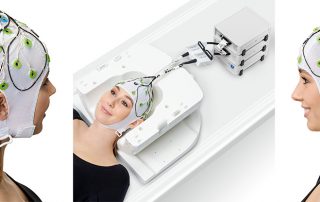
With BrainVision Recorder 2 we also introduced the new BrainVision Recording Format (BVRF). It offers modern features like JSON meta data and multi-participant recordings while remaining BIDS-friendly for easy file conversion. Find out how to access the newly recorded files and how to keep working with data in new and established ways.

2026-04-27T12:46:27+02:00April 27th, 2026|Categories: 2026, Issue 1/2026, Support & Tips|Tags: , , , , , , , , , |
  • Motor-based prediction mediates implicit vocal imitation

Motor-based prediction mediates implicit vocal imitation

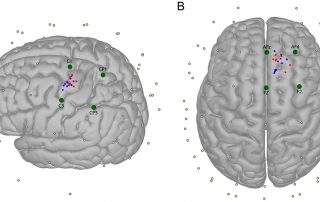
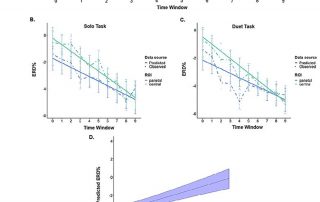
Phonetic convergence—the unconscious adaptation of speech to match interlocutors —is thought to arise from predictive mechanisms. Our research reveals that motor-based predictions enhance neural sensitivity to listener-matched features. This discovery highlights how internal signals orchestrate sensorimotor interactions to guide vocal imitation.

How to design trigger codes to obtain accurate markers

Creating event markers with hardware triggers requires trigger codes. Designing codes for a specific study can be unintuitive and error prone. Here we provide you with a practical strategy to design trigger codes with a structured trigger plan. To help you to create a trigger plan, we introduce trigger2marker, a freely downloadable MATLAB® tool.

2024-12-17T15:32:52+01:00December 13th, 2024|Categories: 2024, Issue 3/2024, Support & Tips|Tags: , , , , |

Brain Products on MATLAB® File Exchange

Check out Brain Products’ new account on the MATLAB® File Exchange. From now on, we will upload all the MATLAB®-based code for the various interactions between MATLAB® and our hardware- and software to this hub. In a first step, we have provided example code for the Remote Control Server 2 (RCS) and Remote Data Access (RDA). In addition, we uploaded the code mentioned in the "How to design trigger codes ..." article - published in this issue of our newsletter.

2025-03-25T19:35:53+01:00December 13th, 2024|Categories: 2024, Issue 3/2024, Support & Tips|Tags: , , , |
  • TriggerBox Plus

How to use the new TriggerBox Plus in your recording setup

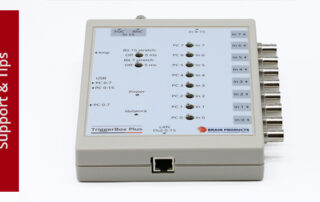
In our last newsletter issue, we proudly introduced the new TriggerBox Plus. Now, we want to provide some more information on how this new and enhanced version of the TriggerBox changes the way you can interact with this device and how you can make the best use of its new features.

2023-12-15T12:01:22+01:00December 15th, 2023|Categories: 2023, Issue 3/2023, Support & Tips|Tags: , , , , , , , |
  • Translating visual perception from the lab to the real world using mobile EEG and mixed reality displays

Translating visual perception from the lab to the real world using mobile EEG and mixed reality displays

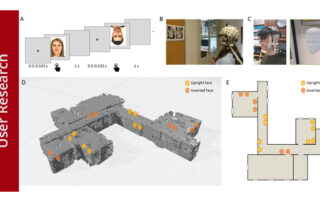
This research combines mobile EEG and augmented reality (AR) to study cognition. Participants completed three face inversion tasks: (1) computer-based, (2) mobile EEG with photographs, (3) mobile EEG with AR. We find face inversion effects in all tasks, concluding that mobile EEG and AR is a promising approach for research.

  • BCI+

Getting started with LSL Markers and Hardware Triggers for Stimulus Presentation

Here we introduce a step-by-step guide for both LSL markers and hardware triggers with Brain Products and various stimulus presentation software programs that will ensure you are ready to start your experiments with the most accurate timing possible.

2022-08-25T19:23:50+02:00August 25th, 2022|Categories: 2022, Issue 2/2022, Products & Applications|Tags: , , , , , , |
  • Safety and data quality of EEG recorded simultaneously with multi-band fMRI

Safety and data quality of EEG recorded simultaneously with multi-band fMRI

Until recently, there has been little information about EEG data quality and safety when used with newer multi-band (MB) fMRI sequences. Here, we measure the relative heating of a MB protocol compared with a standard single-band (SB) protocol considered to be safe. We also evaluated EEG quality recorded concurrently with the MB protocol on humans.

  • TurboLink – new solution enabling ultra-fast brain state-dependent research

TurboLink – new solution enabling ultra-fast brain state-dependent research

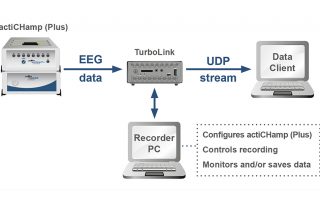
More and more applications require a setup which allows, data access within minimal time, but maximal reliability. We recently released TurboLink for actiCHamp (Plus) and partnered up with sync2brain and their bossdevice RESEARCH to offer a solution that makes sure you can always rely on the performance of your hardware setup.

Go to Top